
How to Choose a Crypto Exchange: A Quick Checklist (Fees/Security/INR Support)

If you’re new to crypto in India, the hardest part is rarely picking a coin. It’s probably picking the place where you will buy it. Lots of platforms promise low costs, strong security and smooth rupee deposits, and almost all of them sound convincing on their homepage. Learning how to choose a crypto exchange is really about separating what a platform says from what you can actually check.
In this guide, we’ll walk you through the checklist I rely on for any crypto exchange comparison: legal standing, crypto exchange fees, INR support, security and exchange liquidity.
Key Takeaways
- Start with registration. An exchange serving Indian users should be registered with FIU-IND, which is a baseline and not exactly a safety guarantee.
- Judge crypto exchange fees by total cost including trading fee, 18% GST, withdrawal charges, spread and TDS.
- Good INR support means easy deposits, easy withdrawals, clear limits and, for derivatives, settlement in rupees.
- Trust protection you can verify like wallet setup, custody, account controls and honest communication after incidents.
- Exchange liquidity shows up as slippage, so check the order book before large orders.
- Match the exchange to what you trade. Delta Exchange India, for example, is built primarily for futures and options traders rather than simple spot buy-and-hold investors.
- Run your own numbers. One exchange rarely wins every category.
Step 1: Confirm the Exchange Is Registered in India
Before I look at fees or features, I check one thing: is this platform registered in India? Since 2023, crypto exchanges serving Indian users are treated as reporting entities under the Prevention of Money Laundering Act. In practice, that means registering with the Financial Intelligence Unit of India (FIU-IND) and following KYC and anti-money-laundering rules.
It’s best to be careful here, because this is where marketing often oversells. FIU-IND registration tells you an exchange sits inside India’s compliance perimeter. But it does not mean the government vouches for its finances or guarantees your funds. I treat it as an entry ticket, not a trust badge.
Here is what I usually look for:
- The registered company name and FIU-IND registration number, usually in the website footer or legal pages.
- A proper KYC process that asks for PAN and other government ID.
- Published terms of use, a privacy policy and an AML policy.
- Support you can actually reach, not just a chatbot loop.
If an exchange skips KYC entirely, I take that as a red flag.
Delta Exchange India comes in handy in this case as it states that it’s registered with FIU-IND under the PMLA and that it onboards users through KYC using PAN and Aadhaar verification. That’s the right pattern to look for.
Step 2: Add Up the Real Crypto Exchange Fees
Almost every crypto exchange comparison I’ve come across starts with the trading fee, and almost every one stops there too. I’d say that’s a mistake, because the headline percentage is only one slice of what you pay. This is the list I add up:
- Trading fee: Usually split into maker (you add an order to the book) and taker (you match an existing order). Takers generally pay more.
- GST: In India, 18% GST is charged on top of the trading fee, so a 0.1% fee effectively becomes 0.118%.
- TDS: A 1% tax deducted at source applies to crypto transfers, with yearly thresholds that vary by taxpayer type. It is not the exchange’s fee, but it affects your cash flow.
- Deposit and withdrawal charges: INR deposits, INR withdrawals and crypto withdrawals can each cost something different, and crypto withdrawals also carry blockchain network fees.
- The spread: The gap between the best buy and sell price. On a “zero fee” trade, the spread can quietly become your real cost.
- Subscriptions and tiers: Some platforms now offer flat monthly plans or volume-based discounts. These suit frequent traders, while occasional buyers may do better paying per trade.
In my view, the spread is the most overlooked item here. A zero-fee platform with a wide spread can cost more than one charging a small, clearly stated fee.
Here is why this matters. If you trade, let’s say, twenty times a month, a tiny difference in fee rate, multiplied by volume and GST, becomes a real number by year-end. If you buy once a quarter, a monthly subscription could cost more than the trades themselves.
For a sense of how published rates look, cryptocurrency trading platforms like Delta Exchange India lists standard fees plus 18% GST on top.
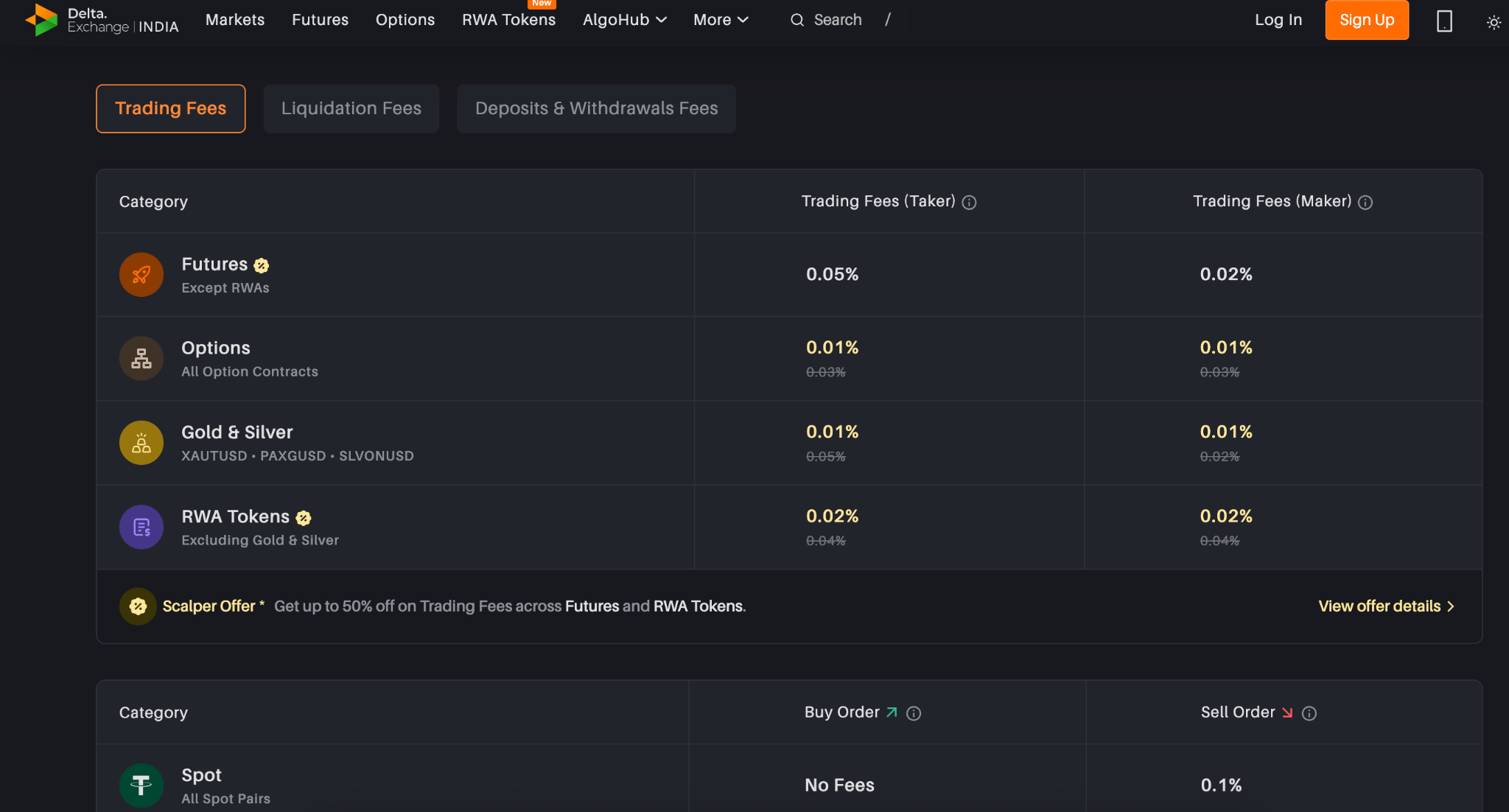
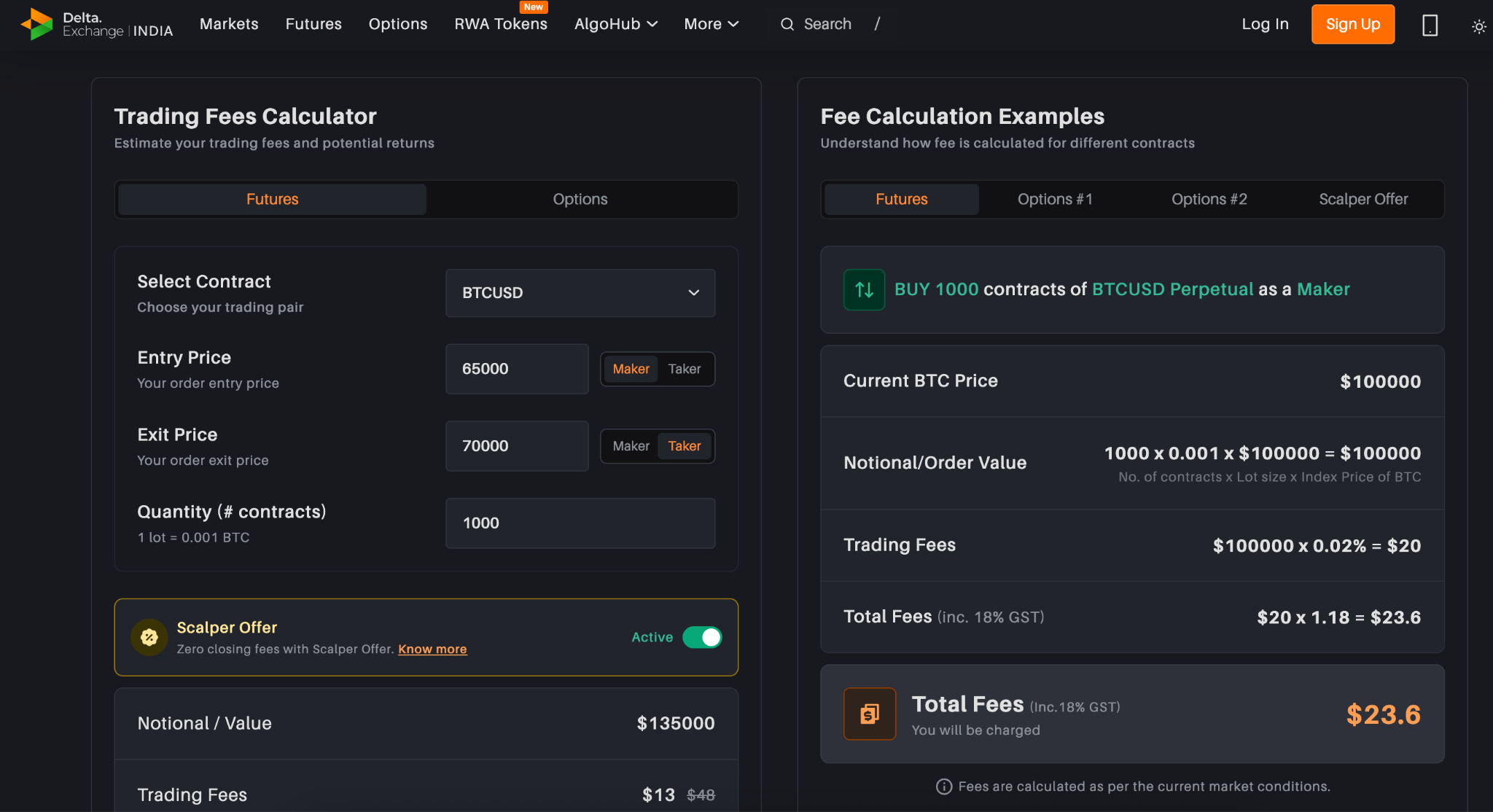
Choose an exchange that has a transparent fee structure that actually helps users
My advice would be to keep a note of your own pattern (trade size, frequency, and whether you hold or trade) and run it through each exchange’s crypto fee calculator.
Step 3: Test INR Support Beyond the Deposit Button
For Indian users, INR support is super convenient - almost essential. Plenty of platforms make depositing rupees easy and withdrawing them slow, so I like to check both directions. These are the questions I ask:
- Which INR methods are supported, such as UPI, IMPS or bank transfer, and what are the limits?
- How quickly do INR withdrawals usually arrive, and do they cost anything?
- Does the exchange verify bank account ownership? This protects you from fraud but can delay a first withdrawal.
- If you trade derivatives, do positions settle in rupees or in a dollar-pegged stablecoin like USDT?
When profits and losses settle in USDT, you carry an extra conversion step (and cost) due to exchange-rate exposure between USDT and INR. Platforms like Delta Exchange India, settle futures and options directly in rupees, which keeps your records simpler, especially at tax time. Plus, it also supports UPI and IMPS and there’s no fees on INR deposits and withdrawals.
Finally, you might want to test the platform’s support before you need it. Send a small deposit, then a small withdrawal, and see how the team responds if something is delayed?
Step 4: Check How Your Money Is Protected
- Wallet setup: Check how customer crypto is stored. Offline cold storage and multi-signature wallets both make theft harder than a single hot wallet.
- Custody structure: Find out whether an institutional custodian holds the assets or the exchange handles everything in-house.
- Where your rupees sit: It’s a good sign when INR balances stay within the Indian banking system and link to your own registered bank account.
- Account controls: Look for app-based 2FA, automatic logout for idle sessions, withdrawal whitelists and login alerts. These are essential.
- Transparency: Look for proof-of-reserves reports or regular transparency updates. They are imperfect, but their absence tells you something.
- Incident history: Several exchanges worldwide, including Indian ones, have been hacked in recent years. Now sure, a past incident doesn’t automatically disqualify a platform. But it’s certainly a red flag.
And of course - use a unique password, switch on 2FA, and never share an OTP with anyone claiming to be support.
Step 5: Check Exchange Liquidity Before Big Orders
Exchange liquidity sounds technical, but the idea is pretty simple: how easily can you buy or sell at a price you want?
On a liquid exchange, plenty of buyers and sellers sit close to the current price. On a thin one, your order has to chew through several price levels, so you pay more, or receive less, than the price you saw on screen. That gap is called slippage.
Here’s how to check it:
- Open the order book for the pair you plan to trade, such as BTC/INR, and see how much volume sits near the best price.
- Look at the bid-ask spread. A tight spread usually signals healthy liquidity.
- Check trading volume at different times of day, not just the 24-hour total.
- Place a small test order first if you are unsure.
If you trade a few thousand rupees, you will barely notice any difference. If you move a few lakh in one go, deep and shallow books feel very different. Liquidity also varies by pair, so an exchange can be strong in Bitcoin and thin in a smaller altcoin. Strictly derivatives-focused platforms may also have less depth than the largest global exchanges, which is worth knowing before you size up.
A Ten-Minute Crypto Exchange Comparison You Can Do Yourself
Reading multiple review sites helps less than one small exercise of your own. This is my routine:
- Shortlist two or three FIU-IND registered exchanges. Include one INR-settled derivatives platform like Delta Exchange India if you plan to trade futures or options.
- Note down your typical trade size and trades per month.
- Calculate total cost on each, including GST and a realistic spread.
- Try a small deposit and a small withdrawal.
- Open the order book for your main pair at two different times of day.
- Read the security and custody pages. Note anything vague.
Then decide what matters most to you. A long-term holder who buys monthly may value simple INR deposits and sturdy custody over the lowest per-trade fee. An active derivatives trader may care more about contract variety, lot sizes and settlement currency.
Mistakes I Would Avoid
- Choosing only on the lowest headline fee.
- Treating star ratings as research.
- Making a large first deposit before testing withdrawals.
- Using maximum leverage just because it is offered.
- Forgetting that crypto losses can’t be set off against other income.
That’s a Wrap
Knowing how to choose a crypto exchange boils down to a few honest checks rather than a perfect answer. Confirm the registration, add up the true crypto exchange fees, test INR support with small amounts, verify the protection claims you can, and look at exchange liquidity for the pair you trade.
Do that, and most marketing noise falls away. I would rather you spend an hour on this now than discover a hidden cost or a slow withdrawal after you have already committed serious money. Start small, stay curious, and revisit your choice as your trading habits change.
FAQs
- Is FIU-IND registration enough to call an exchange safe?
Answer: Not really. It confirms the platform is within India’s compliance framework, but it is not a guarantee of financial strength or security. Check wallet setup, custody, 2FA and transparency too.
- What matters most when comparing crypto exchange fees?
Answer: Total cost, not the headline rate. Add GST, spread, withdrawal charges and your own trading frequency.
- How can I check exchange liquidity quickly?
Answer: Open the order book for your pair, check the bid-ask spread and compare volume at different hours. A small test order shows actual slippage.
- Do I still pay tax if the exchange is registered?
Answer: Yes. Registration does not change your tax duties. India taxes crypto gains at a flat 30% (plus cess), with 1% TDS on transfers, and Budget 2026 left both unchanged. Keep your trade records and confirm current rules with a tax professional.
- How often should I review my exchange choice?
Answer: Once or twice a year should be good, or whenever fees, rules or your trading style change. Platforms update pricing and policies, so a quick recheck keeps surprises away.